Wednesday, 21 October 2015

Volkswagen Golf GTE: car review | Martin Love | Technology | The ...

Volkswagen Golf GTE: <b>car review</b> | Martin Love | Technology | The <b>...</b>


Volkswagen Golf GTE: <b>car review</b> | Martin Love | Technology | The <b>...</b>

Posted: 10 Oct 2015 10:00 PM PDT

Turn it on: Golf's GTE is part electric and part petrol, with a promise of 166 miles to the gallaon.

Price: £28,755 (with government grant)
Top speed: 138mph
0-62mph: 7.6 seconds
MPG: 166

After the scandals in sport, food and banking (doping, horse meat, Libor and the rest), only a fool would have bet against the motor industry not cheating the system, too. But no one would have fingered Volkswagen as the culprit. A byword for trust and decency for more than 75 years and the jewel of the German automotive industry, all reduced to lousy tricksters in the space of a single afternoon. That old adage that a good name takes a lifetime to win and a moment to lose has never been more true.

It was ironic, for me at least, that the day Michael Horn, VW's US boss, stood up and said: "We've screwed up!" was also the day I found myself at the wheel of the new Golf GTE. The E in the title stands for Electric, while the GT is for Gran Turismo and tells new customers (and God knows they're going to need them) that this isn't just some dull electric buggy affair (a golf buggy!) but a full-on driver's car that shares the same sporting DNA as the brand's most famous performance badge – the GTi. It's certainly a tricky balancing act for this VW to pull off as the car has to be both parsimonious and powerful. A sort of vegan Tarzan.

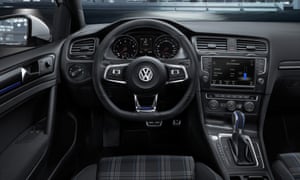
Inside story: the Golf, despite its futuristic powertrain, will be familiar to all VW drivers.

Inside story: the Golf, despite its futuristic powertrain, will be familiar to all VW drivers.

The car is a plug-in hybrid with both a 1.4 TSI petrol (no diesel here) and a snappy electric engine. It has five operating modes: pure electric, electric plus, battery hold, battery charge and auto hybrid. VW has made the technology that controls each option incredibly straightforward, but like many others, I suspect, after fiddling about with the various settings, I clicked on auto hybrid and let the car sort itself out. It seemed to know what it was about far better than me, anyway. Whichever mode you select the car always pulls away in pure electric and it takes a while to get used to that sudden, silent lurch.

All the extra gubbins associated with two engines and a large battery mean that the car is 300kg heavier than the standard model. That's like driving everywhere with the Fijian rugby team's front row sitting in the back. Despite all that heft the car still feels quick and agile around the park (rather like the Fijians themselves) which is testament to the raw power of the GTE. It does 0-62mph in 7.6 seconds with a top speed of 138mph.

Inside and out the car is almost identical to every other Golf on the road. One of VW's e-mobility taglines is "The future is familiar" – and the GTE is certainly that. Within minutes of taking the wheel you feel completely at home. It's one of VW's great strengths that its cars can be totally fresh and yet familiar all at the same time.

Being a hybrid, the car's eco credentials are clearly what sets it apart. It has a range of 31 miles using its fully charged electric engine alone (and most daily journeys are a lot less than that), and it will do up 580 miles on a single tank if both systems are engaged. VW claims an average of 166mpg (depending on how you drive, of course) with emissions of just 39g of CO2 per km. But, and a BUT could not be BIGGER, what's the point of it?

How could one arm of VW be producing such a clever, clean machine while its other has sold more than 11m motors that knock out anything up to 40 times the pollution they claim? I fear that VW's so-called "defeat device" will defeat a lot more than it was intended to.

Email Martin at martin.love@observer.co.uk or follow him on Twitter at @MartinLove166

On the road: Honda Civic Type R – <b>car review</b> | Technology | The <b>...</b>

Posted: 09 Oct 2015 10:00 PM PDT

In my day, a Honda Civic looked like the car you would drive if you were going on an IT training course in Milton Keynes and wanted to fit in: reliable, characterless, neither large nor small, fast nor slow. At some point in the intervening decade, the designers or maybe the entire Honda brand have had a midlife crisis.

If I utter the phrase "black with red detailing", you'll think you know what I mean; you do not. The body looks like a Batmobile. The wheels look as though they were deliberately conceived as fresh wounds – a kind of Bruce Willis-esque aesthetic statement: "I'm so hard I haven't even noticed I'm bleeding." There is a spoiler at the back so substantial and proud that it would only really make sense if this vehicle could fly.

Taxi drivers give you vaudeville thumbs-ups, and young men ogle it, on one occasion at traffic lights swarming round it to touch it. It was like Suddenly Last Summer, with the Civic as Elizabeth Taylor. Another guy pulled up next to me at lights and asked me to rev it so he could hear what it sounded like.

It is insanely powerful. I felt like the Hulk bursting out of his shirt. A top speed of 167mph and a 0-62 of under six seconds are bold but entirely credible claims. It meets no definition of the word "civic" that I can think of.

The engine is pretty noisy, but there's something about it that sounds more encouraging than invasive. The handling is incredible even if you don't hit the +R button, which turns the controls an angry red, firms up the suspension so it's like driving on solid rubber and acts like a formal… no, written… no, embossed invitation to drive too fast. "Dear young idiot, listen to that horsepower! Wouldn't you like to go much, much faster? How'd you like to corner at 120mph? What do you think I'll sound like if you rev the hell out of me?" It's like a love letter from death. OK, that's melodramatic: a billet doux from irresponsible road use.

The interior has perky elements: I like the sparkling steel of the pedals, the sporty posture forced by the bucket seats and the noisy reds of the seatbelts and suedette. Oddment stowage is pesky – the shelf between driver and passenger sits at an awkward height and the glove compartment sheers away in a style that is meant to suggest dynamism (I'm guessing) but makes it quite hard to reach. The economy is better than you'd expect but, at 38.7mpg combined, nothing to boast about; commensurately, emissions are such that you'd have to park round the corner if you were visiting eco-warriors. You'd have to do that with most people, though: it would be hard to arrive in this car without raising questions about your ego.

Photograph of Honda Civic interior

Price £32,295
Top speed 167mph
Acceleration 0-62mph in 5.7 seconds
Combined fuel consumption 38.7mpg
CO2 emissions 170g/km
Eco rating 6/10
Cool rating 8/10

Apple Might Not Build a <b>Car</b> Itself | MIT Technology <b>Review</b>

Posted: 08 Oct 2015 09:00 PM PDT

Apple could subcontract the manufacturing required to produce a car and focus on the software, which is becoming ever more important.

Automobile production might seem a stretch for a company more accustomed to making handheld electronic gadgets and software.

While Apple has yet to make any official announcement, or even to comment on the speculation, mounting evidence suggests the company is at least exploring the development of automotive technology.

But how would an Apple car be manufactured? Industry experts say the company could produce vehicles in much the same way that it makes iPhones and watches: by outsourcing the production of components and contracting with existing manufacturers. What's more, as cars become more electrified and computerized, Apple's existing expertise in software, user interfaces, and batteries may become an increasingly valuable asset.

Apple has hired robotics engineers with expertise in the sensing and control capabilities needed for self-driving vehicles. One industry source recently told MIT Technology Review he met with engineers at an Apple-owned subsidiary to discuss automated driving technology. And according to sources quoted recently in the Wall Street Journal,the Apple car could become a commercialized product by 2019. Apple and some automotive suppliers contacted declined to comment for this article.

"It seems hugely aggressive, but not necessarily impossible," says David Keith, a professor at MIT's Sloan School of Management who studies the way new technologies proliferate through the automotive industry.

Keith adds that the car industry has seen a glut of production capacity, meaning Apple could quite easily take over an existing factory somewhere. And he suggests that producing an electric vehicle would be simpler because batteries and electric motors are already fairly commoditized. "If you aren't building an engine, it is really putting all the parts together and painting it," he says.

Others agree that Apple could most certainly manufacture a car but say it may prove difficult to do so efficiently and cost-effectively.

"I've always thought that making cars was a little tougher than most realize," says Jay Baron, CEO of the Center for Automotive Research (CAR), a nonprofit organization based in Ann Arbor, Michigan. "Anyone can make a car, but try making one every few minutes that people want to buy, and that allows you a profit without significant government support. There's the challenge."

Apple already makes software that transports an iPhone's interface to a car's infotainment system.

Even though most carmakers currently operate their own factories, a few vehicles are produced through contract manufacturing. For example, a major Canadian auto supplier called Magna produces the G-Class on behalf of Mercedes and the Mini for BMW. Google has made prototype driverless cars using components from several suppliers, with contract manufacturing performed by an automotive company called Roush.

Joseph Lull, a project manager at Denso, another large major supplier of car components and technology, pointed out that upstart carmakers such as Tesla, Detroit Electric Cars, and Phoenix outsourced their first models. "You could potentially pull together enough suppliers to do it," he says. "The biggest challenge would be the logistics."

In this regard it may be relevant that Apple's CEO, Tim Cook, has built up a reputation for being able to understand and manage complex electronics supply chains. Lull, asked if his company is currently working with any major consumer electronics firms, said: "None that I can talk about."

All the experts contacted by MIT Technology Review agreed that the big opportunity for Apple lies in creating the software that will shape drivers' future experience behind the wheel. Cars are already heavily computerized, but their computer systems are now becoming more connected, both internally and wirelessly to the Internet. And software companies are arguably well placed to develop technology such as automated driving.

Already a car's interface is becoming an important distinguishing factor, and both Google and Apple are also making a foray into automobiles through software that puts the capabilities of a smartphone in the dashboard of a vehicle (see "Rebooting the Automobile"). This raises the prospect that existing carmakers could become more akin to hardware suppliers in the PC and smartphone world.

"Many existing automakers are very worried about Silicon Valley doing exactly this to them," says MIT's Keith. "They worry that Uber or Google or Apple will have the relationship with the customer and provide the value-added services, while the traditional automakers just become part of the supply chain."

An existing car company, then, might be interested in partnering with Apple rather than be overtaken. Some experts say such a partnership would also help Apple produce high-quality vehicle hardware to go with its software.

Bert Bras, a professor in the mechanical engineering school at Georgia Tech, says it would also cost many billions for Apple to go into manufacturing for itself. "Apple has lots of money," he says. "But rather than starting from scratch, I suspect they would partner with a foreign, perhaps Chinese, automaker."

However, Bras warns that the complexity of the challenge should not be underestimated. "Just take a look at Volkswagen," he says. "They could not get their own diesel engine to work like they wanted, and they are experts in engines and cars."

Gain the insight you need on cars at EmTech MIT.

Register today

Tuesday, 20 October 2015

Acura, Porsche Drop Ranks in Annual Reliability Survey

Acura, Porsche Drop Ranks in Annual Reliability Survey


Acura, Porsche Drop Ranks in Annual Reliability Survey

Posted:

Brands that have built a reputation on reliability are starting to see a decline, according to Consumer Reports' Annual Auto Reliability Survey.

Numerous automakers saw significant drops in ranking this year with Acura and Cadillac both falling seven spots to 18th place and 25th place, respectively. Attributing to Acura's issues were in-car electronics and transmissions in the newest RLX and TLX models, while Cadillac owners were not pleased with the CUE infotainment system as well as platform issues with the Escalade SUV. View the complete list of automakers and how they ranked in the Annual Auto Reliability Survey below.

SEE ALSO: Top 10 Most Reliable Car Brands

1) Lexus

Lexus continues to lead the way in reliability, earning an average score of 64 percent with seven models in its lineup. The company's ranking on the Annual Auto Reliability survey remains unchanged compared to last year.


2) Toyota

With a dozen cars in its lineup, Toyota stayed steady as well at second place with an average score of 56 percent.


3) Audi

The top German automaker when it comes to reliability, Audi rose two spots to third place with eight models in its lineup and an average score of 41 percent.


4) Mazda

The third of four Japanese brands in the top five this year, Mazda dropped one spot to fourth place with an average score of 35 percent across four models.


5) Subaru

Subaru rose two spots to fifth place with seven models in its lineup and an average score of 28 percent.


kia-k900

6) Kia

Korean automaker Kia saw one of the biggest jumps, climbing from 10th place to 6th place. The company has six models and received an average score of 27 percent.


7) Buick

Buick technically tied Kia with a score of 27 percent with five models in the American automaker's lineup. Compared to last year, Buick dropped one spot, although that could be argued since Kia had the same reliability score albeit with one more model in its lineup.


8) Honda

Thanks to infotainment glitches in its redesigned and freshened vehicles, Honda saw a surprising drop of four spots down to eighth place. The company had four models ranked with an average score of 13 percent.


9) Hyundai

Hyundai is also on the rise, jumping four spots to ninth place this year with an average score of six percent across 10 models.


10) MINI

British automaker MINI didn't make any moves this year, sticking to its 10th place with an average score of one percent for two models.


11) BMW

Although BMW got an average score of zero percent, it rose three positions to 11th place with seven models ranked.


volvo-xc90

12) Volvo

Volvo was another brand that stayed steady for the year sticking to 12th place with an average score of -3 percent. The Swedish automaker had four models ranked for this year's Auto Reliability Survey.


13) Volkswagen

Perceived reliability with Volkswagen could change now that the diesel scandal has broke, but the company managed to climb four spots to 13th place with an average score of -7 percent across eight models.


14) Porsche

Another automaker that saw a sharp decline in reliability, Porsche fell five spots to 14th place, netting an average score of -8 percent on five models. The publication attributed Porsche's woes to a decline with the Cayman, while the Macan had a "below-average debut."


15) Nissan

Nissan managed to rise one spot to 15th place with an average score of -18 percent with nine models.


16) Lincoln

Falling into the "Least Reliable" category, Lincoln dropped one spot to 16th place with an average score of -27 percent across three models.


17) Ford

American automaker Ford jumped six spots but reliability remains a concern for the company. It had an average score of -28 percent on 13 models but moved up thanks to strong performance by the redesigned F-150 and Expedition SUV models.


acura-rlx

18) Acura

Acura suffered significantly this year in reliability as we mentioned before, plummeting seven spots to 18th place. It had an average score of -28 percent on four models and the company will have to focus on fine-tuning its RLX and TLX models in order to improve.


19) GMC

GMC didn't move compared to last year's survey, sticking to the 19th spot with a score of -46 percent across eight models.


20) Chevrolet

Chevrolet saw a slight improvement, going up one spot to 20th place. Still, the American automaker has an average score of -48 percent on 11 models.


21) Mercedes-Benz

The lowest of the three major luxury German automakers, Mercedes-Benz did climb three spots to 21th place but still has an average score of -49 percent with six models.


22) Chrysler

Chrysler also didn't change for the year, staying at 22nd place with an average score of -49 percent across three models.


23) Dodge

Sister brand Dodge saw an improvement of two places, rising to 23rd place. It's not all good news for the American automaker however, since it has an average score of -52 percent across six models.


infiniti-q50

24) Infiniti

Unlike Nissan that saw an improvement, luxury arm Infiniti fell four spots to 24th place with an average score of -55 across three models.


25) Cadillac

Like Acura, Cadillac fell seven spots to 25th place with an average score of -91 percent on five models.


26) Ram

Sitting at the bottom of the list are three brands that have built a reputation on poor reliability. Ram remained in 26th place with an average score of -95 percent with two models.


27) Jeep

Jeep came second to last with an average score of -97 percent across four models.


28) Fiat

Lastly, Fiat continues to struggle in reliability rankings, sticking to 28th place with an average score of -177 percent – significantly worse than Jeep.

Discuss this story on our Acura Forum

Loading, please wait...

Bentley Mulsanne Spied Testing on the Nurburgring

Posted:

The Bentley Mulsanne has been caught testing on the Nurburgring by spy photographers.

The luxury sedan is getting a facelift and previously, AutoGuide.com's spy photographers caught the long-wheelbase model testing. The camouflage is hiding the basic components of a facelift, including the updated front end with new headlights and outer lights that are in a different, lower position than the current model. The grille has gotten some minor changes while the front bumper is a bit sportier.

SEE ALSO: Size Matters: Longer Bentley Mulsanne Spied Testing

The rear isn't as telling, and it's unclear whether the British automaker is making any changes. It is likely that the tail lights will get updated with new graphics. As for under the hood, expect Bentley to tweak the engine just a tad to give it a bit more power and better fuel economy. Also, don't be surprised if there are minor changes to the interior with an updated infotainment system and new advanced safety features.

Discuss this story on our Luxury Lifestyle Forum

Loading, please wait...

10 Great Performance Engines We Will Miss

Posted:

Each year, engines come and go as automakers find better ways to get more performance while also improving fuel economy.

We're now entering an era where there is a replacement for displacement, and that's in the form of forced induction. There was a time when turbocharged and supercharged engines were hard to come across, especially from the factory, but now they're everywhere, powering anything from an entry-level Mercedes-Benz CLA250 to an exotic Ferrari 488 GTB.

SEE ALSO: Top 10 Best Sounding V8 Engines

AutoGuide.com took a look at 10 great performance engines we'll miss and are wondering whether or not their replacements are truly better.


BMW E90 / E92 M3 V8 Engine

bmw-s65-engine

Introduced in the BMW E90 and E92 generation M3 models, the 4.0-liter naturally aspirated V8 engine turned out 414 horsepower and 295 pound-feet of torque when it was first introduced in 2007. In 2010, BMW tweaked the S65 engine to a 4.4-liter V8 that provided 444 hp and 320 lb-ft of torque that was used in the 2010-2011 BMW M3 GTS coupe and 2011 BMW M3 CRT sedan. The powerplant was derived from the BMW V10 found in the M5 and M6 and featured an aluminum construction. The engine went on to capture the International Engine of the Year awards for the 3.0- to 4.0-liter category in 2008, 2009, 2010, 2011 and 2012.

Since then, the German automaker has replaced the engine with a 3.0-liter turbocharged V6 engine with 425 hp and 406 lb-ft of torque. Some say the M3 and M4 just aren't the same without a V8 under the hood, while others are more than happy with a turbocharged mill lurking in the engine bay.


Buick Grand National Turbo V6 Engine

buick-grand-national-engine

In the late 1980s, Buick produced a 3.8-liter turbocharged V6 engine packing 245 hp and 335 lb-ft of torque that was used in the Grand National. To bid farewell to the Grand National model, Buick produced 500 limited edition GNX models that saw its performance improved to 300 hp and 420 lb-ft of torque. We're talking about a coupe that went zero to 60 in 5.4 seconds in the late 1980s, turning in a quarter mile time of 13.4 seconds.

Unfortunately, those days are long gone, and the most popular Buick turbo engine you'll find these days are lurking under the hood of a Regal in the form of a 2.0-liter unit with 259 hp and 295 lb-ft of torque.


Dodge Neon SRT-4 Turbo Engine

neon-srt-4-engine

Some say the Dodge Neon SRT-4 was ahead of its time, while others are glad it was only manufactured from 2003-2005. When it was first introduced, the SRT-4 was powered by a 2.4-liter turbocharged four-cylinder engine with 215 hp and 245 lb-ft of torque, but a year later, the American automaker increased that to 230 hp and 250 lb-ft of torque, thanks to larger fuel injectors and an updated ECU. The Neon SRT-4 reportedly went zero to 60 in 5.3 seconds with the more powerful setup while clocking a quarter mile time of 13.9 seconds.

Nowadays, Dodge's definition of an exciting turbocharged engine in a sport compact is a 1.4-liter mill with 160 hp and 184 lb-ft of torque found in the Dodge Dart.


Honda / Acura Integra Type-R Engine

honda-b18c5

If you're a Honda or Acura fan, this engine needs no introduction. The famous B18C5 was used in the Acura Integra Type-R as a 1.8-liter four-cylinder with 195 hp and 130 lb-ft of torque. Not amazing numbers by any imagination, especially compared to today, but it had a redline of 8,400 rpm and it screamed once VTEC kicked in. The focus of the Integra Type R was to minimize weight while increasing rigidity, something nearly all automakers pay attention to now to improve fuel economy and performance. Less than 4,000 units were ever produced in the U.S. and back then, the B18C5 set the record for most power-per-liter from a naturally aspirated engine in the U.S. That record was broken with the S2000's 2.0-liter engine that made 120 hp per liter.


Mazda RX-7 Rotary Engine

mazda-13b-rew

There's a reason why everyone is clamoring for Mazda to revive the rotary engine. The twin-turbo 13B-REW engine was used in the last-generation RX-7 and provided 280 hp in its final iteration. As a twin-turbo version of the 13B engine, its total displacement was 1.3 liters, but it had a pair of sequential turbochargers to help eliminate turbo lag. Sadly, Mazda replaced the RX-7 with the RX-8 that featured the naturally aspirated 1.3-liter two-rotary engine that peaked with 232 hp and 159 lb-ft of torque.


Mercedes-Benz 5.4L Supercharged Engine

mercedes-sl55-engine

There was a time when Mercedes-Benz turned to superchargers for increased performance and one of its greatest was the M113 5.4-liter supercharged V8 engine. It was used in numerous models across the 55 AMG lineup, including the CL55, S55, SL55, E55, G55 and CLS55 from model years 2002-2009. Performance ranged from 469 hp to 510 hp and 516 lb-ft of torque to 531 lb-ft of torque.

Since then, Mercedes has fallen in love with Biturbo engines for its 63 lineup powered by a 4.0-liter V8 mill handcrafted from AMG. In the new C63 AMG, it churns out 469 hp, while the C63 S AMG gets 503 hp. The German automaker also uses a 5.5-liter Biturbo V8 found in the E63 S that pumps out 577 hp.


Mitsubishi Evolution 4G63 Engine

mitsubishi-4g63

One of the few engines that has truly lasted for decades is the Mitsubishi 4G63, a 2.0-liter four-cylinder engine that is most well known for its turbocharged variant found in the Lancer Evolution models. The same mill was also used in the Eclipse and Eagle Talon turbo models as well as numerous race cars. It has also been a favorite among tuners worldwide, having the capability of producing some insane performance when built and equipped with an upgraded turbo and fuel system. Sadly, we are bidding farewell to the Mitsubishi Lancer Evolution this year, exiting with 291 hp, although the automaker replaced the 4G63 in 2007.


Nissan Skyline RB26DETT Engine

skyline-rb26dett

It's not even an engine that was ever available in the U.S., but it was still sought after like no other. Used in the R34 Nissan Skyline GT-R, the RB26DETT may have been rated at 276 hp and 289 lb-ft of torque, but much of that was due to a "gentleman's agreement" between Japanese automakers to limit the horsepower advertised. Enthusiasts in the U.S. have imported the engine and it has found its way into various other vehicles such as the Nissan 240SX, with tuners having reached the 1,000-hp mark numerous times. The RB26DETT was a 2.6-liter inline-six twin-turbo engine.

Nissan went on to replace the RB26DETT with what's found in the current GT-R today, a 3.8-liter twin-turbo V6 engine with up to 600 hp in the GT-R NISMO model.


Toyota Supra 2JZ-GTE Engine

toyota-supra-2jz

No performance engine list would be complete without what is arguably the king of sadly discontinued engines: the Toyota Supra's 2JZ-GTE. To this day, tuners are pushing them to the limits well more than 1,000 hp and can be seen under the hood of quarter-mile specialists worldwide. The 2JZ-GTE was developed as a response to Nissan's successful RB26DETT engine, so it's no surprise that it's also an inline-six engine, albeit with 3.0 liters of displacement. From the factory, it produced 320 hp, but performance figures can hit more than 500 with just bolt-on turbo upgrades. In fact, many tuners have safely pushed power to the 700-hp mark without even cracking open the bottom end.


Volkswagen "Clean" Diesel Engines

2015-volkswagen-golf-tdi-engine

It's probably a bit premature to say we'll miss Volkswagen's "clean" diesel engines, but in light of the massive dieselgate scandal, we couldn't help ourselves. It's still unclear as to what will happen with Volkswagen and its diesel engine that has been caught cheating on EPA diesel emissions tests, but the German automaker is working on a fix and a recall for current owners. The big question is whether shoppers will consider Volkswagen diesel models in the future and whether or not Volkswagen will continue to invest into developing diesel engines, especially when hybrids and electric vehicles are taking hold of the market. For now, they'll continue to exist, but the 2016 models won't even be sold for quite some time as Volkswagen has withdrawn its EPA application for those vehicles.

Loading, please wait...

Watch This Excellent, Growly, Drifty Footage of the New BMW M4 GTS

Posted:

BMW has released some awesome footage of its new M4 GTS, and it's our first chance to see and hear BMW's fastest production model in action.

Put through its paces at the Anglesey Circuit in the U.K., the hardcore BMW M4 GTS looks in its natural element, easily drifting through tight turns and rocketing through straightaways.

Powered by a turbo 3.0-liter inline six with 493 hp and 442 lb-ft of torque, the M4 GTS blasts to 62 mph in just 3.8 seconds.

ALSO SEE: 2016 BMW M4 GTS Announced With Power Boosting Water Injection System

Only 700 2016 BMW M4 GTS models will be made worldwide, with just 300 of those heading to the U.S.

Watch the video below:

Get the Flash Player to see this player.

Discuss this story on our BMW Forum

Loading, please wait...

Redesigned Volvo V90 Leaked Through Scale Models Again

Posted:

Another design for an upcoming Volvo has been leaked with photos of a scale model of the 2016 Volvo V90 surfacing on a Chinese car site.

Heavily influenced by the Estate Concept Car that debuted at the Geneva Motor Show last year, the V90 scale model hints that the car modernizes the classic wagon lines by adopting Volvo's stylish new corporate grille. The tail lights also take on a swanky new shape.

ALSO SEE: 2017 Volvo S90 Leaked in Model Car Photos

Twin chrome tailpipes, a dual sunroof, and roof rails can also be seen on the model car, along with Volvo's now signature T-shaped LED headlights.

The car will be built on the Swedish automaker's SPA platform and will likely have the same engine choices as the XC90, meaning a "twin-charged" 2.0L turbocharged/supercharged four-cylinder with 316 hp and 295 lb-ft of torque, as well as a plug-in hybrid model.

The actual Volvo V90 is expected to be officially revealed next year.

[Source: CarNews China]

Discuss this story on our Volvo Forum

Loading, please wait...

Hyundai Tucson ‘Adventuremobile’ Coming to SEMA

Posted:

Another modified Hyundai Tucson project is heading to the 2015 SEMA Show.

Dubbed the "Adventuremobile," this Tucson will be built by John Pangilinan and blends the crossover platform with a passion for the great outdoors, making it the ideal vehicle for a weekend getaway. Most prevalent of the modifications is a Treeline Tamarack roof-top tent, allowing room to sleep two campers while Goal Zero solar panels help power all the accessories. The car's exterior is more outdoors friendly as well, thanks to an Aries bull bar and side steps and Rigid Industries LED lighting. The exterior of the Tucson will be covered in a BASF army green paint scheme by Strasse Sport.

SEE ALSO: Hyundai Previews Insane Tucson with 700+ HP

For greater ground clearance, the Tucson has been lifted 1.5 inches while Rays Gram Lights 57DR wheels have been outfitted on each corner, paired to Toyo Open Country A/T II tires. Engine performance upgrades are kept at a minimal, but the Tucson does get a slight boost with an AEM intake and charge pipe kit as well as a Magnaflow exhaust system.

On the inside, Pangilinan has equipped the Tucson with Katzkin custom leather upholstery and a Truck Vault Storage with Trekpak system. The audio system has been thoroughly upgraded with products from Clarion and Scosche.

"Designed with the weekend adventurer in mind, the Tucson was the perfect platform for an 'Adventuremobile,'" said John Pangilinan. "The build blends performance with the excitement of the great outdoors, without sacrificing daily usability. The vehicle promotes exploration, making it ideal for the daily commute, weekend excursions, and the occasional road trip."

Discuss this story on our Hyundai Forum

Loading, please wait...

Friday, 9 October 2015

On the road: Mitsubishi L200 Barbarian – car review | Technology ...

On the road: Mitsubishi L200 Barbarian – <b>car review</b> | Technology <b>...</b>


On the road: Mitsubishi L200 Barbarian – <b>car review</b> | Technology <b>...</b>

Posted: 02 Oct 2015 10:00 PM PDT

Mitsubishi L200 Barbarian.

The Mitsubishi pick-up has "Barbarian" in lights across every conceivable surface. It is incredibly beefy and, in the wrong hands, indeed a barbarian. You could back into an innocent Zafira as easily as turning on the radio. The parking camera is worse than useless, slow to respond and, in consequence, wrong about almost everything. But you don't get a pick-up because it's easy to park. You get it if you need to pick up a lot of stuff. It's too large to get into a city dump without a licence, so it's not your amateur's pick-up. This is a planner's pick-up.

In rear-wheel drive, it is a bit like a tractor. The gear stick carries on shaking as you turn off the engine. It makes so many noises, I kept thinking there was a police car behind me. "Even the windows are too loud," said a haughty seven-year-old from the back. Modern cars, I realised, try to mask the raw mechanics, and there is none of that here. Anything you can't hear, you can feel vibrating. Primary ride events come at you like a fairground attraction: if you can see a crater coming, you know you're going to feel it. But secondary ride events are significant, too: a seam in the road you wouldn't even see will knock you around like a squally wind. It's like driving a shed. "Why are these cowardly cyclists scattering before me?" I asked my mister. "Have you seen the size of yourself?" he replied.

Indeed, it's so heavy that the determining factor in performance is not engine size but gravity: going down the slightest incline, you can be in fourth at 20mph and not even feel it. Going uphill, you have to floor it in third just to get on to a slip road.

I was so high up in the cabin, I was at eye level with white vans and other pick-ups. You sort of acknowledge each other – it's hard not to – and I nod, trying to imagine what it would be like if I really were working. Apparently, these are very popular with American agents (it's an ironic thing: "Any normal person would be in a Hummer; we could afford one, but prefer this") and with Islamic State (along with the Toyota Hillux and Mitsubishi Warrior).

In the absence of a higher ironic purpose or an ideological war, it made sense to me only with a party of 10-year-olds on the flatbed, screaming their way around a car park in Surrey Quays (which I definitely did not do, but was hypothetically hilarious). It is neither a city car, nor a country car. It's a working car, like a working dog: not as charming as a regular one, but more impressive.

Price £28,558.80
Top speed 111mph
Acceleration 0-62mph in 10.4 seconds
Combined fuel consumption 42.8mpg
CO2 emissions 173g/km
Eco rating 5/10
Cool rating 8/10

On the road: Kia Sorento – <b>car review</b> | Technology | The Guardian

Posted: 25 Sep 2015 10:00 PM PDT

The Kia Sorento is the kind of car that will cause acquaintances to ask, "What are you driving now?" when you arrive. If you like that kind of thing – and God knows, I love it – you'll burst with pride. It has a slightly militaristic exterior, more imposing in black, I should think; in white more redolent of plain money. It's long, wide and low, spacious inside, bullish on the road. There are potentially three rows of seats, though I never needed them and left the boot as was. As low as it is, the boot is an extremely high jump for an elderly dog, not that I would ever put a dog in his twilight years in a review car, oh no.

City driving, as with anything not designed for a city but that city people love to drive, is not ideal: it's sluggish in the lower gears. If you're in first and second a lot, you may feel vexed by the effort. But cruising is a pleasure: give it an A road or a motorway and it will take care of itself. The acceleration is confident, the steering is true, the traction is reassuring, the handling invites trust, the leather seats make you feel as though everything's going to be OK.

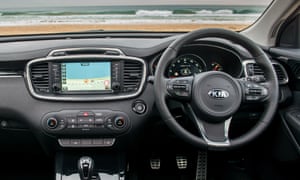
The driving position is well thought-out, everywhere from the posture to the armrest. The room in the cabin really tells if you're one of those people who lurches into a car with two litres of water and a load of handheld devices you forgot to charge. The satnav, from its classy 8in screen to the intuitiveness of its controls, is a pleasure: it is one of the injustices of the world of cars that you feel moved to comment on satnav only if it sucks. Then, once in a while, it's great, and you remember to mention it.

It is the first time, by popular lore, Kia has ever come up with anything you'd want to spend 30 grand on, so they're naturally pretty proud. 0-62mph in nine seconds is quite fun, though you never feel as though you're taking off. It has the safety features du jour, which revolve mainly around an insane number of airbags and a lot of alarms – blind spot, lane discipline and rear cross traffic alert (this translates in the real world into a noise you don't understand, until the hazard passes you or recedes) – and the fuel consumption is decent.

The question is, would you fall in love with it? If you think of SUVs as a bid for status, then a moderately priced one would seem pointless. But if you genuinely need a giant car that a dog can't get into or out of, then it's a good, solid, novel entry into the class.

Kia Sorrento detail.

Price £35,845
Top speed 124mph
Acceleration 0-60mph in 9 seconds
Combined fuel consumption 46.3mpg
CO2 emissions 161g/km
Cool rating 7/10
Eco rating 6/10

Mercedes-AMG G63 6x6 <b>Review</b> | Autocar

Posted: 28 Feb 2013 09:37 PM PST

This is the lunatic six-wheel Mercedes G63 AMG 6x6, the largest and most extreme road legal SUV to ever hail from Mercedes' road car operations.

Produced on a limited basis – and at a price of £370,000 – the colossal double-cab pickup started life as an even more rugged military version of the G320 CDI conceived and engineered for the Australian army and in operation since 2011.

This plush, leather-lined civilian version of the off-road vehicle has been conceived to appeal to some of Mercedes-Benz's most affluent clientele.

It features six driven wheels, low range gearing, five differential locks and a tyre control system for its standard 37-inch wheels. Mercedes says it is "the last word in forward-thrusting power for the beaten track".

Unlike the military version of the G320 CDI 6x6, which is fitted with Mercedes-Benz's 3.0-litre V6 diesel and is offered in outputs of up to 220bhp, the G63 AMG 6x6 gets a twin-turbocharged 5.5-litre V8 from AMG with 536bhp. Torque is a 560lb ft – crucial in providing the shove required to haul the big four-seater's considerable 3775kg kerb weight.

Mercedes' 7G-tronic seven-speed automatic transmission is fitted in place of the old NAG1 five-speed auto 'box found on the army version. Its transfer case can alter between a 0.87:1 high-range ratio for on-road driving and 2.16:1 low-range ratio for off-road conditions to all six wheels in a nominal 30:40:30 split. Power for the rearmost axle is supplied by an extra shaft. There are five electronic differential locks offering 100 per cent lock up of all six wheels, operated by three switches on the dashboard.

Relaying the engine's strong reserves to the ground are massive 37-inch wheels featuring a bead-plate design. They are shod with 12.5in-wide wheels. 

At 5875mm in length, 2110mm in width and 2210mm in height, the G63 AMG 6x6 is 1106mm longer, 225mm wider and 272mm higher than the G63 AMG. Along with a 300mm increase in the wheelbase through to the middle axle at 3120mm, the front and middle axles have increased in width by 281mm each at 1790mm, requiring widened and lengthened carbonfibre guards to cover the huge wheels.

Ground clearance is a whopping 460mm while fording depth is put at 1000mm – some 250mm and 400mm more than the standard car. Approach and departure angles have been increased by 16 degrees and 27 degrees at 52 degrees and 54 degrees respectively, while the breakover angle has increased by 1 degree at 22 degrees.

To drive, it's a blast, at least in the wide-open space of a Dubai desert where the G63 AMG 6x6 has sufficient room to strut its stuff. I'm not sure how it would fare during the morning rush hour, but there's no doubt you'd be noticed. And really, that's what this new Mercedes-Benz is all about. 

That said, the example we drove was terrifically engineered – as complete from a technical standpoint as you'd expect any model from the German car maker whose first 6x6 customer deliveries are planned to get underway in just six months' time. 

Before we got behind the wheel, we were taken for a wild ride over the dunes by a Mercedes test driver, who performed a round of donuts to prove how well engineered the G63 AMG 6x6 really is. The fact that it was originally conceived for military use helps, of course. The big surprise is just how refined it is. 

Once you've heaved yourself on to the substantial step plate and introduced your backside to the leather-lined comfort of the G63 AMG 6x6's heavily contoured sport seat, you discover a cabin changed little from the standard G63 AMG up front.

The upright driving position is old school, as is the steeply angled windscreen and shallow dashboard. But forward vision is brilliant and indicators mounted on the front fenders act as positioning points. Rear vision is hampered by the tall rear seatbacks and a small two-piece sliding rear window.

At 3120mm, there's a 300mm increase in wheelbase to the first of the rear axles. It provides a longer cabin than the standard G63 AMG – and with it additional rear legroom. There's a liberal covering of Alcantara throughout and the standard three-across rear bench seat is replaced by two individual AMG sport seats. They get electronic backrest adjustment and are divided by a rear centre console.

There's an engaging blare through the four sidepipes as you hit the starter button to fire the engine, lending the big Mercedes an eager demeanour. Blip the throttle and it squats on its springs under load change like a true muscle car.

Once underway, the G63 AMG 6x6 proves remarkably easy to drive. It may have been conceived for the rough-and-tumble of army duties in the Australian outback, but the work put in to converting it for civilian use has produced a straightforward nature together with level of comfort you'd hardly credit from such an extreme-looking machine. 

In the dunes of the Dubai desert, the G63 AMG 6x6 feels invincible. Those big tyres work with the complex driveline to provide plenty of traction, allowing you to wind it up to regular motorway speeds on narrow sandy tracks without any great trepidation. 

It cruises with great authority, providing longitudinal stability – far better than the regular G63 AMG owing to the longer wheelbase and added traction provided by the third axle. There's far less vertical movement through the suspension than the standard car, resulting in a surprisingly smooth ride. There's plenty of lean in corners, but body movements are controlled thanks to a unique spring and damper package developed specifically for the G63 AMG 6x6.

Despite its weight, it accelerates with great vigour. Heady torque combines with the traction-enhancing qualities brought by the six-wheel-drive system to deliver impressive off-the-line and in-gear qualities. Mercedes won't quote official acceleration claims just yet, but insiders suggest 0-62mph in less than six seconds. Top speed, limited by its balloon-like tyres, will likely be electronically governed to 100mph.

And consumption? Again, Mercedes is yet to publish official figures, but we're told to expect around 15mpg on the European test cycle. It's just as well that the G63 AMG 6x6 will come with two fuel tanks with an overall capacity of 159 litres.

The prototype's vague, hydraulically-operated steering, which is geared at a lazy 3.4 turns lock-to-lock, indicates the need for some fine-tuning to better suit the big tyres. But any doubts about dynamic ability on the back of its rugged good looks were quickly dispelled. 

Even when confronted with steep dunes and daunting sink holes, the hulking SUV managed to take it all in its stride, powering on with determination and a baritone exhaust note. Excellent wheel articulation and myriad diff lock combinations keep all six wheels firmly planted on the ground for impressive progress. An onboard compressor with four 20-litre tanks fitted along the sides of the underbody allow you to adjust tyre pressures, taking just 20sec to increase from a stand-friendly 0.5bar up to the 1.8bar required for on-road use – much faster than a conventional system that typically takes around 10mins.

The only thing I've driven that comes remotely close to the feeling I got while at the wheel of the G63 AMG 6x6 is the Hummer H1. But while the former is incredibly nimble for something so vast and hugely powerful, the latter was stodgy and rather lethargic. 

You could argue long and hard about the merits or otherwise of the G63 AMG 6x6 – surely the world's first road legal MUV (monster utility vehicle). However, one thing holds true: it is a fun thing to drive in the right conditions.

But with a price tag more than three times that of the G63 AMG, it is going to be a super-exclusive proposition for all but the mega-rich.

DS 5: <b>car review</b> | Martin Love | Technology | The Guardian

Posted: 26 Sep 2015 10:00 PM PDT

On the road: the DS 5, built with the air of a grand tourer. Photograph: Daniel Pullen

Price: £25,980
Engine: 1.6-litre 4cyl diesel
Power: 118bhp
Transmission: six-speed manual, front-wheel drive
0-62mph: 12.7 seconds
Top speed: 119mph
CO2: 104g/km
MPG: 70.6

The birds that perch in the trees opposite my house are not fans of the new DS 5. They made their displeasure clear with a night of strategic bombing. God only knows what they'd been gorging on, but they created a proper splatterfest. One of those you end up scraping at with a thumbnail. And I sort of agreed with them – not that I'd have expressed it in the same way.

Some cars are so much more photogenic than others. In pictures the DS 5's high bonnet and swirling chrome detailing give the impression of a nicely balanced vehicle, surging athletically up the road. But in the flesh it looks awkward: its bonnet and vast sweptback windscreen too big for its body, like one of those egg-headed dogs Princess Anne is so fond of.

Rear view: the back of the DS 5, featuring the new logo and twin exhausts.

Rear view: the back of the DS 5, featuring the new logo and twin exhausts.

I haven't mentioned the C-word yet because, despite what you might think, this is no longer a Citroën. DS split from its parent company last year and its double chevron has now been replaced with a sinuous D kissing a flirty S.

Launched 60 years on from the original DS, which still captivates with its curves and ingenuity, this DS probably won't be celebrated in quite the same breathless way in 2075. However, DS is keen to establish itself as a constructor of premium cars which stand out from the crowd, and it has made every effort to combine ambitious styling with good comfort, dynamic technology and a decent engine.

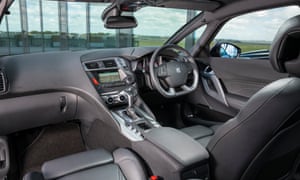
Step in and you'll find an interior which is quirky and different, but not always in a good way. The seats are strikingly padded with leather blocks which look both retro and modern – especially in the Toffo-tan colour mine was. The dashboard is clutter-free thanks to half the buttons having migrated to a central strut overhead between the twin sunroofs (there's also a third glass panel above the back seats). But rather than feeling light and airy, the interior feels oddly claustrophobic and unsettling.

Inside story: the interior is light and airy thanks to the huge windscreen.

Inside story: the interior is light and airy thanks to the huge windscreen.

The 1.6-litre BlueHDi diesel which I tested is economical and superbly quiet. You might be underwhelmed if you wanted to hare round corners, but on a long cruise it's admirably unflustered and the fuel economy is excellent. The steering wheel feels big in your hands, which goes against the trend for smaller, sportier styles.

Speed bumps are a tiresome issue round me – though not for my wife, who happily slams over them, bouncing the rear axle sickeningly into the air. I once persuaded the kids in the back to wear their cycle helmets to make a point, but that only encouraged her. However the DS 5, with its upgraded suspension, coped brilliantly, easing gracefully over every sleeper. However I'm not sure this new car will enjoy as smooth a ride further down the road.

Email Martin at martin.love@observer.co.uk or follow him on Twitter at @MartinLove166

A <b>Car</b> That Knows What the Driver Will Do Next | MIT Technology <b>...</b>

Posted: 30 Sep 2015 09:00 PM PDT

Researchers trained a computer to recognize the behavior that precedes a particular maneuver.

An experimental new dashboard computer can not only keep track of your behavior behind the wheel, but even predict what you're about to do next.

With the vast majority of road accidents resulting from driver error, and distraction a growing problem thanks to the ubiquity of smartphones, carmakers are increasingly exploring ways to track driver behavior behind the wheel. Volvo, GM, and others are already testing systems that will monitor head and eye positions to pick up on signs of distraction.

A study by researchers at Cornell University and Stanford shows that a more advanced system could be trained to recognize the body language and behavior that precedes a particular maneuver. This could help trigger an early warning system, such as a blind spot alert, much earlier—perhaps thereby helping to prevent serious accidents, according to the academics involved.

"Imagine you are driving on a highway," says Saxena Ashutosh, the director of a project called Robo Brain at Cornell University and Stanford who oversaw the driving project. "You look to the right for a second, because you are going to make a right turn, and as you are starting to make a right turn, some other driver has pulled into the space that you thought was empty." A car could then either issue an alert or even prevent you from pulling into the lane.

The system was trained using cutting-edge machine-learning algorithms, and it could predict, with just over 90 percent accuracy, when a driver was about to change lanes in the next few seconds. A lane change was usually signaled by a glance over the shoulder along with telltale head movements and changes in steering, braking, and acceleration. Ashutosh says the accuracy achieved is almost good enough to be used in a production system.

This video shows the features used by the system to track a driver's head movement.

The researchers behind the work are exploring different ways for a vehicle to monitor and anticipate driver behavior through a project called Brain4Cars.

The work involved using a machine-learning approach called deep learning to recognize the actions that preceded the lane-change maneuver. The algorithms were trained using data collected as 10 different people drove a total of 1,180 miles around different areas of California. The researchers intend to make the resulting data set freely available so that other academics and auto researchers can make use of it.

Deep learning has proven especially useful in recent years for recognizing complex or subtle patterns in data such as video and audio (see "10 Breakthrough Technologies 2013: Deep Learning"). It is already used to enable vehicle computers to recognize different types of obstacles on the road. In the latest work, the team combined data from a video camera with GPS data and information from a car's computer systems.

Many luxury cars now come with sensors that enable safety warnings, as well as automatic breaking and steering. Ashesh Jain, a student of Saxena's and project lead on Brain4Cars, says monitoring activity inside a car, as well as outside of it, could make such safety systems more intelligent. "Suppose the driver is distracted for a second," he says. "If there's nothing in front, the car should be smart enough, and not alert the driver. It's about how you use information from all these sensors."

More than 90 percent of U.S. road accidents are the result of some sort of driver error, according to research conducted by the National Highway Traffic Safety Authority.

Paradoxically, monitoring driver behavior could become more important even as cars become more automated. That's because even if cars drive themselves in some situations, such as on highways or in parking lots, drivers will still need to retake the wheel occasionally, and research has shown that this can take many seconds depending on a driver's level of distraction (see "Proceed with Caution toward the Self-Driving Car"). Google has gone so far as to sidestep the problem by removing the pedals and steering wheel from some of its prototypes altogether.

Don Norman, an expert on product design who has served as a consultant for numerous carmakers and computer companies, says the Brain4Car work is promising, but adds that it will need to be improved further and tested in the real world. "These are simulation data, run in the laboratory," Norman says. "The real world is never as nice as the laboratory. Many factors may change the results when applied to real people driving real cars in real traffic."

Gain the insight you need on emerging technologies at EmTech MIT.

Register today

On the road: Mazda CX-3 – <b>car review</b> | Technology | The Guardian

Posted: 18 Sep 2015 10:00 PM PDT

Mazda CX-3.

They say the compact crossover is a crowded market, but that's only in the sense that any market loosely defined (futures, greeting cards, animal fats) looks crowded. What exactly is the Mazda CX-3? The thing that is larger than the Mazda 2, or the thing that is smaller than the SUV? It's the latter, of course, because everyone loves the word "SUV", but it isn't large enough, least of all in the boot capacity, to warrant the term, even if it technically skims it.

The upside is that it looks neat and sharp. They are funny, Mazda, full of high design concepts: "Kodo" is the unified look across the styles. The CX-3 meets it by being aggressive yet sleek around the nose, tidy through the body, sheered off neatly at the back. Skyactiv is the technology, which they illustrate with a video that pits a CX-3 against a greyhound. It is weird nobody pointed out that most cars are faster than dogs.

Anyway, because it is attractive on the outside, and on the inside has leatherette seating with red piping, and because its variant is "Sport Nav diesel", you expect a thrill. At 10.1 seconds to do 0-62mph, its getaway speed is tasty; it feels much more alive than the Dacia Duster, the other big beast (popularity-wise) in this class. Sometimes nippy cars don't accelerate well in the middle gears, but this was pleasant in all of them, and cruised well. Someone I am acquainted with by marriage complained that the fascia on the doors was the wrong height to lean your elbow on and get a tan on your arm, but otherwise, both driver and passenger position were comfortable.

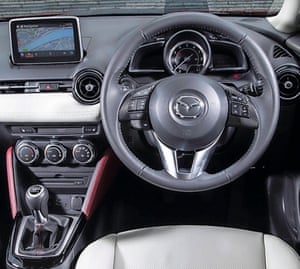
In the cabin, things were spacious and there were likable features; for some reason, the leather-effect stick shift area really pleased me. The touchscreen multimedia system is good on paper but lacks finesse, claiming mid-journey that satnav hadn't been installed after all. The intuition quotient was high, though: there wasn't anything I couldn't guess, except where the seventh speaker was. (Nice to have so many of these, by the way. It got pretty loud, which I like in a car, especially when I don't know where I'm going.)

The ride is a bit bouncy and unpredictable – enough to make you think more about suspense than suspension. It's a bit unfair to talk about primary ride when you take a car to a festival, but it was even a bit of a prima donna when it came to a seam in the tarmac. Melodrama was the only dramatic thing about it; it was sometimes admirable for its competence, but not showstopping.

On the road: Mazda detail

Price £22,435
Top speed 110mph
Acceleration 0-62mph in 10.1 seconds
Combined fuel consumption 70.6 mpg
CO2 emissions 105g/km (diesel)
Cool rating 6/10
Eco rating 8/10